Second home loans in South Carolina
South Carolina taxes a second home on a higher assessment than a primary residence, and on the coast the wind policy is often a separate bill. Both belong in the numbers from the start.
Where second home buying concentrates in South Carolina
South Carolina's second home demand runs the length of the coast and then jumps to the lakes in the northwest corner.
- The Grand Strand, from North Myrtle Beach through Myrtle Beach to Surfside and Garden City, the state's largest resort market and overwhelmingly condominium, much of it built around nightly rental.
- Pawleys Island, Litchfield and DeBordieu, in Georgetown County, a quieter and more single-family version of the same coast.
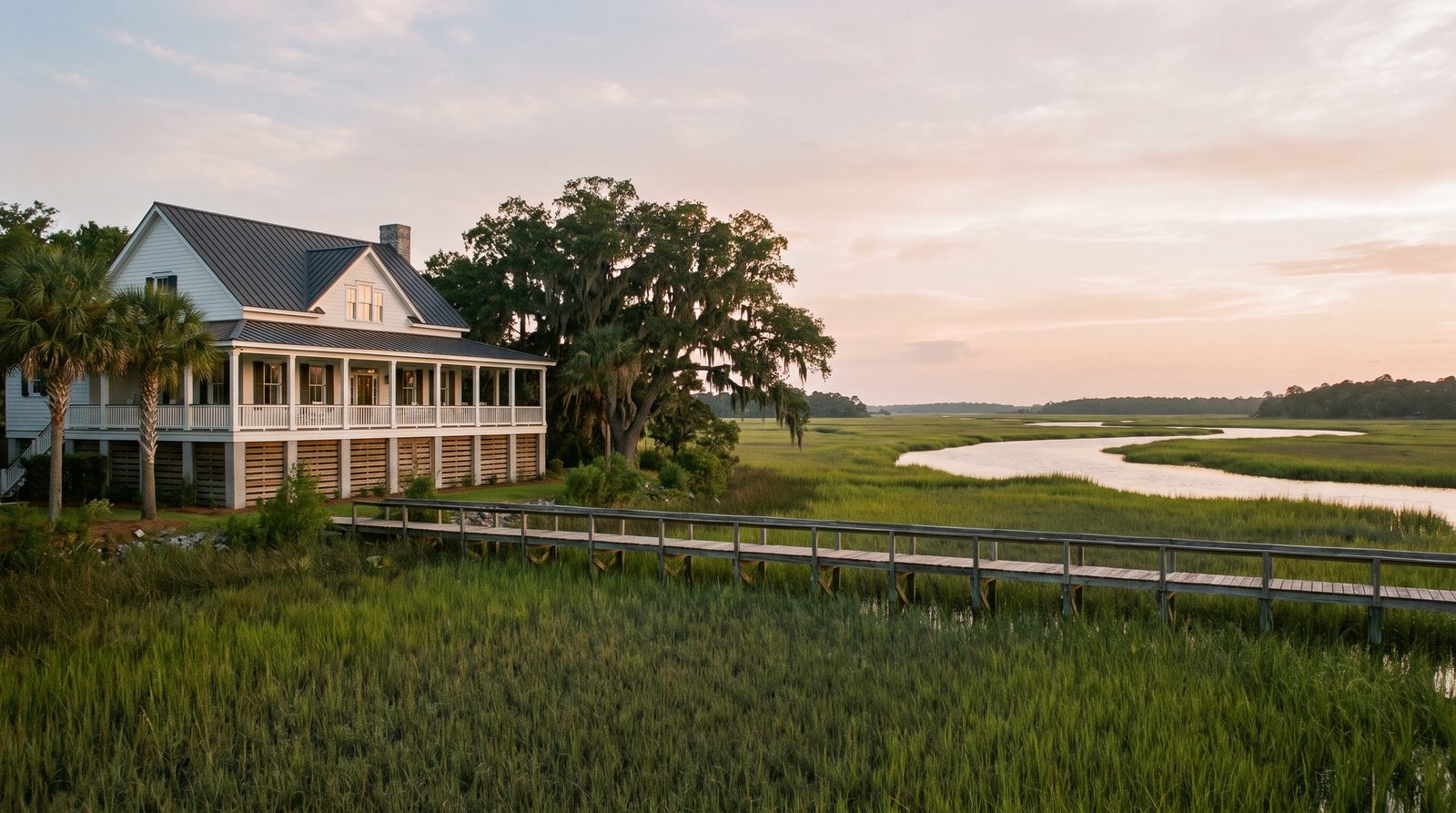
- Charleston and its islands, meaning Isle of Palms, Sullivan's Island, Folly Beach, Kiawah and Seabrook, a mix of beach houses, resort communities and marsh-front property.
- Hilton Head, Bluffton and Daufuskie, in Beaufort County, a market organized largely around gated plantation communities with their own associations and amenities.
- Beaufort, Fripp and Edisto, smaller Lowcountry markets with older housing stock and a strong marsh-front character.
- Lake Keowee and Lake Hartwell, in Oconee, Pickens and Anderson counties, the Upstate lake market, drawing from Greenville, Charlotte and Atlanta.
- Lake Murray and Lake Wylie, near Columbia and Charlotte respectively, close enough to their metros to be used most weekends.
Those are descriptions of where the market is, not a claim about prices or returns. The coast and the lakes raise different questions, and the Grand Strand is a category of its own.
Source: U.S. Census Bureau, American Community Survey 5-year estimates, 2023, tables B25004 and B25001.
What usually decides a South Carolina file
The 6% assessment ratio
South Carolina assesses an owner's legal residence at 4% of fair market value and a second home or vacation home at 6%, before millage is applied. The 4% ratio has to be applied for, requires the house to be the owner's domicile, and is lost if the house is rented for more than 72 days in the tax year. A seller who lived in the property full time may have been paying on the 4% basis, and that bill does not carry over to a buyer who will use it as a second home.
Source: South Carolina Department of Revenue, Individual Property Taxes, Chapter 5, citing S.C. Code Ann. § 12-43-220(c).
Why a lender cares: the tax figure in the debt-to-income calculation is the one the property will carry on the 6% basis. Ask the county assessor for an estimate on that basis rather than relying on the listing's tax figure.
On the Grand Strand, the building is underwritten before you are
A conventional loan on a condominium requires the project to pass a review, and a large share of the Myrtle Beach oceanfront inventory sits in buildings designed around nightly rental. A front desk, on-site check-in, mandatory rental pooling, revenue sharing with the association and a high proportion of commercial space push a project toward being treated as a condominium hotel, which is not eligible for conventional financing as a second home. Reserve funding, the owner-occupancy mix and any active litigation are reviewed in the same pass. Asking for the association's budget and reserve study before the offer goes in is the practical move.
Insurance on the coast is often three policies
Along the South Carolina coast the wind and hail peril is frequently excluded from the homeowners policy and written separately, and flood is separate again. The state's residual market for the wind piece is the South Carolina Wind and Hail Underwriting Association, generally called the Wind Pool, which writes in a defined coastal territory for owners who cannot get the coverage in the open market.
Source: South Carolina Department of Insurance, Wind Pool territory FAQ.
Every one of those premiums, plus association dues on a condominium or in a gated community, goes into the monthly housing obligation used to calculate debt to income. Real quotes during the inspection period, not estimates, keep that off the critical path.
The rental question
Fannie Mae's Selling Guide says a second home cannot be subject to any agreements that give a management firm control over the occupancy
and that the borrower must keep exclusive control of the property. A unit that stays in a rental program after closing is an investment property purchase.
Source: Fannie Mae Selling Guide B2-1.1-01, Occupancy Types.
That is a different loan, not a worse one. The Fannie Mae Eligibility Matrix, August 2026 edition, lists 90% as the maximum loan-to-value on a one-unit second home purchase against 85% on a one-unit investment property.
Source: Fannie Mae Selling Guide, Eligibility.
On Lake Keowee, the dock is a Duke Energy permit
Duke Energy manages the shoreline on Lake Keowee under the Keowee-Toxaway Shoreline Management Plan, and docks, piers and shoreline work need a permit from its Lake Services group. Whether the dock in the listing photographs is permitted, and whether the permit transfers, is a title and appraisal question. On Lake Hartwell the shoreline is federal, and private docks are governed by the Corps of Engineers instead.
Source: Duke Energy Lake Services, Permits for Shoreline Activities.
Which guides matter most here
For a South Carolina purchase, these three carry most of the weight.
Licensing in South Carolina
Residential Mortgage, LLC is authorized to close loans in South Carolina, one of the 27 states on the company's published authorization list. Bryan Piccolomini holds NMLS #228509 and Residential Mortgage, LLC holds NMLS #167729. Both can be checked independently on NMLS Consumer Access. Fuller detail is on the licensing page.
Common questions
Can Bryan lend on a second home in South Carolina?
Yes. Residential Mortgage, LLC is authorized to close loans in South Carolina, one of the 27 states on the company's authorization list, and Bryan Piccolomini holds NMLS #228509.
Why is the property tax higher on a second home?
Because South Carolina assesses it on a different ratio. A legal residence is assessed at 4% of fair market value and a second or vacation home at 6%, before millage. The 4% ratio requires the house to be your domicile, so a seller's bill on the 4% basis is not the bill you will pay.
Can I finance a Myrtle Beach oceanfront condo as a second home?
Often, but the building has to qualify first. Buildings with a front desk, on-site check-in, mandatory rental pooling or revenue sharing with the association can be treated as condominium hotels, which are not eligible for a conventional loan. The association's budget and reserve study are the place to start.
Is wind coverage a separate policy on the coast?
It frequently is. Wind and hail are often excluded from the homeowners policy along the coast, and flood is separate again. South Carolina's Wind Pool writes the wind coverage in a defined coastal territory for owners who cannot get it in the open market. All of those premiums count toward the monthly obligation a lender uses.
Does the dock on a Lake Keowee house need a permit?
Yes. Duke Energy manages the Lake Keowee shoreline and permits docks and shoreline work through its Lake Services group. Confirm the existing dock is permitted, and that the permit transfers, during the inspection period.
More states: all 27. Run the arithmetic first on the calculators page.
Run the numbers on the 6% basis
On a South Carolina second home, the assessment ratio and the coastal insurance decide whether the file works.